

---
title: How To Sell Rental Property and Defer Paying Taxes
description: Learn more about how to sell rental property and potentially defer capital gains tax.
image: https://www.realized1031.com/hubfs/how-to-sell-rental-property-and-defer-paying-taxes-is1498844251.jpg
---

[![Realized 1031 Exchange Marketplace](https://www.realized1031.com/hs-fs/hubfs/Images/Brand/Logo/Realized/Realized-Logo-Black.png?width=240&height=80&name=Realized-Logo-Black.png "Realized 1031 Logo") ](https://www.realized1031.com/)

- [Wealth Management Gap](https://www.realized1031.com/the-wealth-management-gap)
- [Our Process](https://www.realized1031.com/how-realized-works)
- [Financial Advisors](https://www.realized1031.com/advisor)
- [Resources](https://www.realized1031.com/resources)

- [The Company](https://www.realized1031.com/about-us)
- [Articles](https://www.realized1031.com/blog)

[Register](https://www.realized1031.com/marketplace)

[Log In](https://www.realized1031.com/login)

- Better Business Bureau Rating: **A+**
- [FINRA BrokerCheck](https://brokercheck.finra.org/firm/summary/22333)
- [Call](tel:1-877-797-1031) **(877) 797-1031**

# How To Sell Rental Property and Defer Paying Taxes

Posted Sep 13, 2024

![Two people along with a calculator, contract, and rental property](https://www.realized1031.com/hs-fs/hubfs/how-to-sell-rental-property-and-defer-paying-taxes-is1498844251.jpg?width=1024&height=576&name=how-to-sell-rental-property-and-defer-paying-taxes-is1498844251.jpg)

When you are fortunate and able to sell your rental property for a profit from the initial investment you made in it — it’s also a way for you to let go of landlord responsibilities while accessing liquidity.

However, as with selling any property, the sale of a rental property comes with several liabilities, including capital gains taxes.

Capital gains taxes take effect following the sale of assets like rental properties and can amount to thousands of dollars. These taxes can eat into your profits, meaning it may be beneficial to defer or minimize them.

Fortunately, there are several strategies for deferring capital gains on rental property sales.

Learn more about the various tax deferral strategies used by investors like yourself and why a 1031 exchange may be beneficial.

## About Capital Gains Taxes

Before going into the different tax strategies you can use, let’s go over [capital gains tax in rental property sales](https://www.realized1031.com/blog/capital-gains-tax-on-real-estate-what-you-need-to-know).

Capital gains taxes are taxes paid following the sale of real estate assets like rental properties. To derive your exact tax liabilities, the IRS looks into the profit you’ve made from selling your rental property. To the IRS, this is your capital gain, and a percentage of it is taxed.

For example, if you purchased a rental property for $200,000 and sold it for $300,000, your capital gain would be $100,000, which could be subject to taxes.

### Long-Term vs. Short-Term Capital Gains Taxes

One factor in how much capital gains you owe depends on how long you’ve owned the rental property. Depending on the duration you’ve had the rental property, you may [pay long-term or short-term capital gains taxes](https://www.irs.gov/pub/irs-news/fs-07-19.pdf).

You’ll pay short-term capital gains tax if you have had your rental property for less than a year. For the most part, the amount will be at the same rate as your ordinary income tax.

However, if you’ve owned the property for more than a year, you’ll qualify for the lower long-term capital gains tax rate, which ranges from 0% to 20%, depending on your income level.

### How Capital Gains Taxes Impact Your Investment

Unless you belong to a lower income bracket, these taxes can be a significant portion of your sale proceeds. In particular, they may amount to up to [22% of your gain at the federal level](https://www.bankrate.com/investing/long-term-capital-gains-tax/) on top of applicable state taxes.

Because of how much capital gains tax can eat into your proceeds, you need to find ways to either minimize your liabilities or defer them.

## Top Strategies for Deferring Capital Gains on Rental Property Sales

There are several methods you can use to avoid or defer capital gains taxes when selling a rental property.

Below are some of the most effective strategies used by investors like yourself. Leveraged correctly, these tax avoidance and deferral tactics can make your rental property sale more profitable.

### 1031 Exchange

One of the most popular and effective ways to defer capital gains taxes is through a [1031 exchange](https://www.irs.gov/pub/irs-news/fs-08-18.pdf) or like-kind exchange.

A 1031 exchange allows you to defer paying capital gains taxes by reinvesting the proceeds from the sale of your rental property into another [“like-kind” property](https://www.realized1031.com/glossary/like-kind-property). This means you can sell a rental property and buy another investment property without immediately triggering a tax bill.

The primary benefit of a 1031 exchange is the ability to defer paying capital gains taxes, which enables you to reinvest the full proceeds from your property sale. This can help you grow your investment portfolio more quickly and preserve your wealth for the future.

As a bonus, a 1031 exchange is flexible as you can exchange your property for a wide variety of investment properties, including buildings, multi-family units, or even land. You just need to make sure that [the exchange is between properties with similar purposes](https://www.irs.gov/businesses/small-businesses-self-employed/like-kind-exchanges-real-estate-tax-tips) (i.e., investment and commercial purposes).

However, be aware.

While a 1031 exchange is a powerful tool, it does have some potential pitfalls. For one, the strict timeline for identifying and closing on replacement properties can be challenging, especially in a competitive real estate market.

You’ll also need to carefully follow all IRS rules to ensure your exchange qualifies for tax deferral.

### Converting Rental Property to a Primary Residence

You can also defer and minimize your capital gains taxes by converting your rental property into a primary residence. To take advantage of this tax deferral tool, certain eligibility criteria must be met, particularly the duration within which you’ve resided in the property.

If you live in the property for at least two of the five years before you sell it, you may qualify for the primary residence exclusion.

[This exclusion](https://www.nolo.com/legal-encyclopedia/the-250000500000-home-sale-tax-exclusion.html) allows you to exclude up to $250,000 of capital gains from taxes if you’re single. On the other hand, you may be eligible for up to $500,000 if you’re married and filing jointly.

This strategy can result in significant tax savings, especially if your capital gains fall within the exclusion limits. Most importantly, it allows you to benefit from living in the property before selling it.

However, this strategy requires a commitment to moving into the property and living there for at least two years. If your gains exceed the exclusion limits, you’ll still owe taxes on the excess amount as well.

### Tax-Loss Harvesting

Do you have other investments aside from your rental property? If so, you can resort to [tax-loss harvesting](https://www.investopedia.com/terms/t/taxgainlossharvesting.asp).

This tax-reducing strategy works by potentially reducing the capital gains tax on a rental property sale with losses from separate investments.

In other words, if you have other investments that have lost value, you can sell them in the same year you sell your rental property. The losses from these investments can potentially offset the capital gains from your property sale and reduce your overall tax liability.

This strategy is relatively straightforward and can be an effective way to reduce your taxable income. Tax-loss harvesting also enables you to choose which investments to sell and when to sell them.

However, the effectiveness of this strategy depends on having losses to offset your gains. There are also limits on how much of your losses can be used to offset gains each year since you can only write off [up to $3,000 of your losses](https://www.bankrate.com/investing/tax-loss-harvesting/).

## How To Use a 1031 Exchange

Taking advantage of a 1031 exchange requires a careful and meticulous approach, preferably under the guidance of a financial advisor, attorney, or qualified intermediary. Here’s a breakdown of key steps to get the most out of this tax deferral strategy.

### 1. Work Closely With a Qualified Intermediary

A qualified intermediary (QI) makes a 1031 exchange possible.

A QI is a neutral third party that holds the proceeds from your property sale and facilitates the purchase of the replacement property.

Without a QI, your sale and purchase of properties won’t be considered exchanges under IRS Section 1031. As a result, you’ll trigger capital gains taxes following the sale of your property.

### 2. Identify Your Replacement Property

The exchange process begins when you identify a potential replacement property. Replacement properties must be of like-kind, meaning they need to have a similar purpose to the property you’re about to sell.

Once you sell your current property, you’ll have [45 days to identify a replacement property](https://www.irs.gov/pub/irs-news/fs-08-18.pdf). As long as your potential replacement properties satisfy certain criteria, you can select up to three properties. The only condition is that their combined value doesn’t exceed 200% of your sold property.

### 3. Close on the Replacement Property

After choosing your replacement property, it’s time to purchase it. You have [180 days from the sale of your original property](https://www.irs.gov/pub/irs-news/fs-08-18.pdf) to close on the purchase of one or more of the identified replacement properties.

## Key Takeaways

Selling a rental property can be a lucrative endeavor, but the prospect of paying hefty capital gains taxes can make it a daunting task.

Fortunately, as a real estate investor, you have several strategies at your disposal to defer these capital gains taxes.

Of these strategies, the 1031 exchange remains a proven way to defer and minimize capital gains tax in rental property sales. By allowing you to potentially defer 100% of your capital gains, it can be an excellent instrument for maximizing your cash flow for other property investments.

Because a 1031 exchange enables you to buy and sell between multiple property types, it also makes for a great solution for expanding your real estate portfolio.

*The tax and estate planning information offered by the advisor is general in nature.  It is provided for informational purposes only and should not be construed as legal or tax advice.  Always consult an attorney or tax professional regarding your specific legal or tax situation.*

**Sources: **

[https://www.irs.gov/pub/irs-news/fs-07-19.pdf](https://www.irs.gov/pub/irs-news/fs-07-19.pdf)

[https://www.bankrate.com/investing/long-term-capital-gains-tax/](https://www.bankrate.com/investing/long-term-capital-gains-tax/)

[https://www.irs.gov/pub/irs-news/fs-08-18.pdf](https://www.irs.gov/pub/irs-news/fs-08-18.pdf)

[https://www.irs.gov/businesses/small-businesses-self-employed/like-kind-exchanges-real-estate-tax-tips](https://www.irs.gov/businesses/small-businesses-self-employed/like-kind-exchanges-real-estate-tax-tips)

[https://www.nolo.com/legal-encyclopedia/the-250000500000-home-sale-tax-exclusion.html](https://www.nolo.com/legal-encyclopedia/the-250000500000-home-sale-tax-exclusion.html)

[https://www.investopedia.com/terms/t/taxgainlossharvesting.asp](https://www.investopedia.com/terms/t/taxgainlossharvesting.asp)

[https://www.bankrate.com/investing/tax-loss-harvesting/](https://www.bankrate.com/investing/tax-loss-harvesting/)

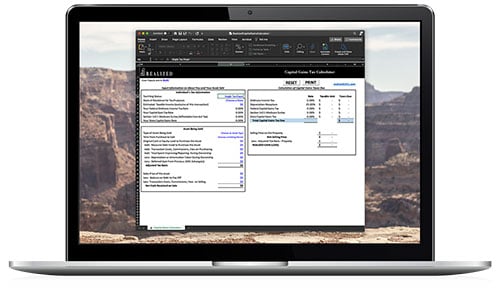
Download The Capital Gains Tax Calculator

[![Cap Gains Calculator For Investors](https://www.realized1031.com/hs-fs/hubfs/Images/UI/graphics/composites/laptop-capital-gains-calculator-spreadsheet.jpg?width=500&height=290&name=laptop-capital-gains-calculator-spreadsheet.jpg "Estimate the cap gains tax owed ...") ](https://www.realized1031.com/blog/how-to-sell-rental-property-and-defer-paying-taxes#blogform)

Download Calculator

---


---

### Cap Gains Calculator For Investors

![Download The Capital Gains Tax Calculator](https://www.realized1031.com/hs-fs/hubfs/Images/UI/graphics/composites/laptop-capital-gains-calculator-spreadsheet.jpg?width=500&height=290&name=laptop-capital-gains-calculator-spreadsheet.jpg)

Estimate the cap gains tax owed after selling an asset or property

By providing your email and phone number, you are opting to receive communications from Realized. If you receive a text message and choose to stop receiving further messages, reply STOP to immediately unsubscribe. Msg & Data rates may apply. To manage receiving emails from Realized visit the Manage Preferences link in any email received.

Search

### [Why Realized](https://www.realized1031.com/why-realized)

- [Wealth Management](https://www.realized1031.com/the-wealth-management-gap)
- [Why Realized](https://www.realized1031.com/why-realized)
- [Our Process](https://www.realized1031.com/how-realized-works)
- [Scenarios](https://www.realized1031.com/scenarios)
- [Private Client Program](https://www.realized1031.com/private-client)
- [Realized Exchange Services](https://www.realized1031.com/realized-exchange-services)

### [The Company](https://www.realized1031.com/about-us)

- [The Team](https://www.realized1031.com/about-us)
- [FAQ](https://www.realized1031.com/frequently-asked-questions)
- [Testimonials](https://www.realized1031.com/testimonials)
- [Press](https://www.realized1031.com/press)
- [Careers](https://www.realized1031.com/careers)

### [Partners](https://www.realized1031.com/partners)

- [Financial Advisors](https://www.realized1031.com/advisor)
- [Broker Dealers](https://www.realized1031.com/partners/broker-dealers)
- [Real Estate Agents](https://www.realized1031.com/partners/real-estate-agents)
- [Certified Public Accountants](https://www.realized1031.com/partners/certified-public-accountants)

### [Resources](https://www.realized1031.com/resources)

- #### Learn
  
    - [Articles](https://www.realized1031.com/blog)
    - [Glossary of Terms](https://www.realized1031.com/glossary)
    - [Capital Gains Tax Rates](https://www.realized1031.com/capital-gains-tax-rate)
- #### Watch
  
    - [Video Library](https://www.realized1031.com/videos)
    - [Webinar Archive](https://www.realized1031.com/webinars)
- #### Read
  
    - [Delaware Statutory Trust](https://www.realized1031.com/delaware-statutory-trust)
    - [Tenants-In-Common](https://www.realized1031.com/tenants-in-common-tic)
    - [1031 Exchange](https://www.realized1031.com/1031-exchange)
    - [Qualified Intermediary](https://www.realized1031.com/qualified-intermediary)
    - [Qualified Opportunity Zones](https://www.realized1031.com/opportunity-zones)

#### Realized

- 500 W 13th Street  
  Austin, TX 78701
- (877) 797-1031

##### [Contact Us](https://www.realized1031.com/contact-us)

- [![Realized on Facebook](https://www.realized1031.com/hs-fs/hubfs/Images/UI/Social/Icons/Mix/social-facebook-whiterev.png?width=60&height=60&name=social-facebook-whiterev.png)](https://www.facebook.com/Realized/)
- [![Realized on LinkedIn](https://www.realized1031.com/hs-fs/hubfs/Images/UI/Social/Icons/Mix/social-linkedin-whiterev.png?width=60&height=60&name=social-linkedin-whiterev.png)](https://www.linkedin.com/company/realized/)
- [![Realized on YouTube](https://www.realized1031.com/hs-fs/hubfs/Images/UI/Social/Icons/Mix/social-youtube-whiterev.png?width=60&height=60&name=social-youtube-whiterev.png)](https://www.youtube.com/c/Realized1031?sub_confirmation=1)

- [![Realized Holdings, Inc. BBB Business Review](https://www.realized1031.com/hs-fs/hubfs/Images/professional-assoc/bbb/RZH2-bbb-seal.png?width=40&height=65&name=RZH2-bbb-seal.png)](http://www.bbb.org/central-texas/business-reviews/real-estate-investors/realized-holdings-llc-in-austin-tx-1000112948/#bbbonlineclick)
- [![FEA Logo](https://www.realized1031.com/hs-fs/hubfs/Images/professional-assoc/fea/RZH2-fea-logo.png?width=82&height=65&name=RZH2-fea-logo.png "FEA Logo")](https://www.1031.org)

SECURITIES DISCLOSURE

Realized1031.com is a website operated by Realized Technologies, LLC, a wholly owned subsidiary of Realized Holdings, Inc. (“Realized Holdings”). Securities and/or Investment Advisory Services may be offered through Registered Representatives or Investment Advisor Representatives of Realized Financial, Inc. ("Realized"), a broker/dealer, member [FINRA](https://www.finra.org)/[SIPC](https://www.sipc.org/), and registered investment adviser. Realized is a subsidiary of Realized Holdings, Inc. ("Realized Holdings"). Check the background of this firm on [FINRA's BrokerCheck](https://brokercheck.finra.org/firm/summary/22333).

Hypothetical example(s) are for illustrative purposes only and are not intended to represent the past or future performance of any specific investment.

Investing in alternative assets involves higher risks than traditional investments and is suitable only for sophisticated investors. Alternative investments are often sold by prospectus that discloses all risks, fees, and expenses. They are not tax efficient and an investor should consult with his/her tax advisor prior to investing. Alternative investments have higher fees than traditional investments and they may also be highly leveraged and engage in speculative investment techniques, which can magnify the potential for investment loss or gain and should not be deemed a complete investment program. The value of the investment may fall as well as rise and investors may get back less than they invested.

This site is published for residents of the United States who are accredited investors only. Registered Representatives and Investment Advisor Representatives may only conduct business with residents of the states and jurisdictions in which they are properly registered. Therefore, a response to a request for information may be delayed until appropriate registration is obtained or exemption from registration is determined. Not all of services referenced on this site are available in every state and through every representative listed. For additional information, please contact the Realized Compliance department at 512-472-7171 or info@realized1031.com.

- [Terms & Conditions](https://www.realized1031.com/terms-and-conditions)
- [Privacy Policy](https://www.realized1031.com/privacy-policy)
- [Form CRS](https://www.realized1031.com/hubfs/common-files/disclosures/FormCRS.pdf)
- [ADV 2A](https://www.realized1031.com/hubfs/common-files/disclosures/ADV2A.pdf)
- [Reg BI Disclosures](https://www.realized1031.com/hubfs/common-files/disclosures/RegBI.pdf)
-  

© 2026 Realized Holdings, Inc.

```json
{
  "@context" : "http://schema.org/",
  "@type" : "BlogPosting",
  "articleBody" : "When you are fortunate and able to sell your rental property for a profit from the initial investment you made in it — it’s also a way for you to let go of landlord responsibilities while accessing liquidity. However, as with selling any property, the sale of a rental property comes with several liabilities, including capital gains taxes. Capital gains taxes take effect following the sale of assets like rental properties and can amount to thousands of dollars. These taxes can eat into your profits, meaning it may be beneficial to defer or minimize them. Fortunately, there are several strategies for deferring capital gains on rental property sales. Learn more about the various tax deferral strategies used by investors like yourself and why a 1031 exchange may be beneficial. About Capital Gains Taxes Before going into the different tax strategies you can use, let’s go over capital gains tax in rental property sales. Capital gains taxes are taxes paid following the sale of real estate assets like rental properties. To derive your exact tax liabilities, the IRS looks into the profit you’ve made from selling your rental property. To the IRS, this is your capital gain, and a percentage of it is taxed. For example, if you purchased a rental property for $200,000 and sold it for $300,000, your capital gain would be $100,000, which could be subject to taxes. Long-Term vs. Short-Term Capital Gains Taxes One factor in how much capital gains you owe depends on how long you’ve owned the rental property. Depending on the duration you’ve had the rental property, you may pay long-term or short-term capital gains taxes. You’ll pay short-term capital gains tax if you have had your rental property for less than a year. For the most part, the amount will be at the same rate as your ordinary income tax. However, if you’ve owned the property for more than a year, you’ll qualify for the lower long-term capital gains tax rate, which ranges from 0% to 20%, depending on your income level. How Capital Gains Taxes Impact Your Investment Unless you belong to a lower income bracket, these taxes can be a significant portion of your sale proceeds. In particular, they may amount to up to 22% of your gain at the federal level on top of applicable state taxes. Because of how much capital gains tax can eat into your proceeds, you need to find ways to either minimize your liabilities or defer them. Top Strategies for Deferring Capital Gains on Rental Property Sales There are several methods you can use to avoid or defer capital gains taxes when selling a rental property. Below are some of the most effective strategies used by investors like yourself. Leveraged correctly, these tax avoidance and deferral tactics can make your rental property sale more profitable. 1031 Exchange One of the most popular and effective ways to defer capital gains taxes is through a 1031 exchange or like-kind exchange. A 1031 exchange allows you to defer paying capital gains taxes by reinvesting the proceeds from the sale of your rental property into another “like-kind” property. This means you can sell a rental property and buy another investment property without immediately triggering a tax bill. The primary benefit of a 1031 exchange is the ability to defer paying capital gains taxes, which enables you to reinvest the full proceeds from your property sale. This can help you grow your investment portfolio more quickly and preserve your wealth for the future. As a bonus, a 1031 exchange is flexible as you can exchange your property for a wide variety of investment properties, including buildings, multi-family units, or even land. You just need to make sure that the exchange is between properties with similar purposes (i.e., investment and commercial purposes). However, be aware. While a 1031 exchange is a powerful tool, it does have some potential pitfalls. For one, the strict timeline for identifying and closing on replacement properties can be challenging, especially in a competitive real estate market. You’ll also need to carefully follow all IRS rules to ensure your exchange qualifies for tax deferral. Converting Rental Property to a Primary Residence You can also defer and minimize your capital gains taxes by converting your rental property into a primary residence. To take advantage of this tax deferral tool, certain eligibility criteria must be met, particularly the duration within which you’ve resided in the property. If you live in the property for at least two of the five years before you sell it, you may qualify for the primary residence exclusion. This exclusion allows you to exclude up to $250,000 of capital gains from taxes if you’re single. On the other hand, you may be eligible for up to $500,000 if you’re married and filing jointly. This strategy can result in significant tax savings, especially if your capital gains fall within the exclusion limits. Most importantly, it allows you to benefit from living in the property before selling it. However, this strategy requires a commitment to moving into the property and living there for at least two years. If your gains exceed the exclusion limits, you’ll still owe taxes on the excess amount as well. Tax-Loss Harvesting Do you have other investments aside from your rental property? If so, you can resort to tax-loss harvesting. This tax-reducing strategy works by potentially reducing the capital gains tax on a rental property sale with losses from separate investments. In other words, if you have other investments that have lost value, you can sell them in the same year you sell your rental property. The losses from these investments can potentially offset the capital gains from your property sale and reduce your overall tax liability. This strategy is relatively straightforward and can be an effective way to reduce your taxable income. Tax-loss harvesting also enables you to choose which investments to sell and when to sell them. However, the effectiveness of this strategy depends on having losses to offset your gains. There are also limits on how much of your losses can be used to offset gains each year since you can only write off up to $3,000 of your losses. How To Use a 1031 Exchange Taking advantage of a 1031 exchange requires a careful and meticulous approach, preferably under the guidance of a financial advisor, attorney, or qualified intermediary. Here’s a breakdown of key steps to get the most out of this tax deferral strategy. 1. Work Closely With a Qualified Intermediary A qualified intermediary (QI) makes a 1031 exchange possible. A QI is a neutral third party that holds the proceeds from your property sale and facilitates the purchase of the replacement property. Without a QI, your sale and purchase of properties won’t be considered exchanges under IRS Section 1031. As a result, you’ll trigger capital gains taxes following the sale of your property. 2. Identify Your Replacement Property The exchange process begins when you identify a potential replacement property. Replacement properties must be of like-kind, meaning they need to have a similar purpose to the property you’re about to sell. Once you sell your current property, you’ll have 45 days to identify a replacement property. As long as your potential replacement properties satisfy certain criteria, you can select up to three properties. The only condition is that their combined value doesn’t exceed 200% of your sold property. 3. Close on the Replacement Property After choosing your replacement property, it’s time to purchase it. You have 180 days from the sale of your original property to close on the purchase of one or more of the identified replacement properties. Key Takeaways Selling a rental property can be a lucrative endeavor, but the prospect of paying hefty capital gains taxes can make it a daunting task. Fortunately, as a real estate investor, you have several strategies at your disposal to defer these capital gains taxes. Of these strategies, the 1031 exchange remains a proven way to defer and minimize capital gains tax in rental property sales. By allowing you to potentially defer 100% of your capital gains, it can be an excellent instrument for maximizing your cash flow for other property investments. Because a 1031 exchange enables you to buy and sell between multiple property types, it also makes for a great solution for expanding your real estate portfolio. The tax and estate planning information offered by the advisor is general in nature. It is provided for informational purposes only and should not be construed as legal or tax advice. Always consult an attorney or tax professional regarding your specific legal or tax situation. Sources: https://www.irs.gov/pub/irs-news/fs-07-19.pdf https://www.bankrate.com/investing/long-term-capital-gains-tax/ https://www.irs.gov/pub/irs-news/fs-08-18.pdf https://www.irs.gov/businesses/small-businesses-self-employed/like-kind-exchanges-real-estate-tax-tips https://www.nolo.com/legal-encyclopedia/the-250000500000-home-sale-tax-exclusion.html https://www.investopedia.com/terms/t/taxgainlossharvesting.asp https://www.bankrate.com/investing/tax-loss-harvesting/",
  "articleSection" : [ "Capital Gains" ],
  "author" : {
    "@type" : "Person",
    "email" : "marketing@realized1031.com",
    "image" : "",
    "name" : "The Realized Team",
    "url" : "https://www.realized1031.com/blog/author/the-realized-team"
  },
  "dateModified" : "2024-09-13T15:00:00+0000",
  "datePublished" : "2024-09-13T15:00:00+0000",
  "description" : "Learn more about how to sell rental property and potentially defer capital gains tax.",
  "headline" : "How To Sell Rental Property and Defer Paying Taxes",
  "image" : {
    "@type" : "ImageObject",
    "height" : 576,
    "url" : "https://733513.fs1.hubspotusercontent-na1.net/hubfs/733513/how-to-sell-rental-property-and-defer-paying-taxes-is1498844251.jpg",
    "width" : 1024
  },
  "mainEntityOfPage" : "https://www.realized1031.com/blog/how-to-sell-rental-property-and-defer-paying-taxes",
  "name" : "How To Sell Rental Property and Defer Paying Taxes",
  "publisher" : {
    "@type" : "Organization",
    "address" : {
      "@type" : "PostalAddress",
      "addressCountry" : "USA",
      "addressLocality" : "Austin",
      "addressRegion" : "TX",
      "postalCode" : "78701",
      "streetAddress" : "500 W 13th Street "
    },
    "logo" : {
      "@type" : "ImageObject",
      "height" : 60,
      "url" : "http://www.realized1031.com/hubfs/Images/Brand/Logo/Realized/Realized-Logo-Black-No-Margin-296x60-AMP.png",
      "width" : 296
    },
    "name" : "Realized"
  },
  "thumbnailUrl" : "https://733513.fs1.hubspotusercontent-na1.net/hubfs/733513/how-to-sell-rental-property-and-defer-paying-taxes-is1498844251.jpg"
}
```